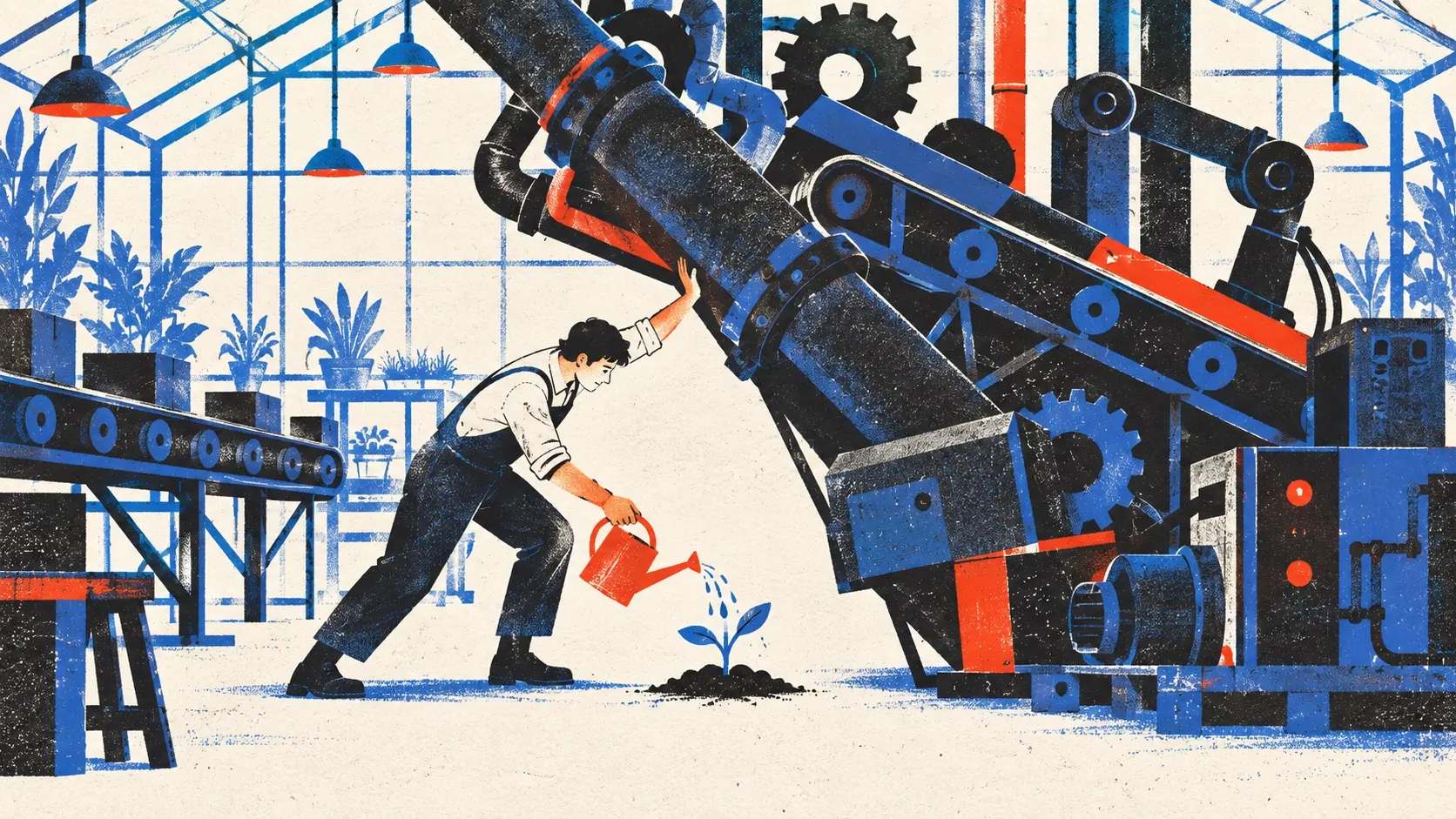
Premature scaling often looks like good work.
The founder builds roles, automation, dashboards, pricing tiers, a partner program, and infrastructure for a crowd that has not arrived. The company becomes excellent at repeating something nobody has chosen.
Do not build the factory while the product is still a question.
Distinguish product-user fit from market pull
A few people may love the product. That matters. It does not yet prove that many similar people can be found, reached, converted, and retained.
Andreessen Horowitz calls the first condition product-user fit: the right product for the right user. Product-market fit needs broader evidence from the market. Confusing the two encourages founders to buy distribution before they understand whom it should find.
Keep the claim modest. “Three independent accountants use this every week and pay for it” is stronger than “we have product-market fit” because it can be inspected.
Keep the founder in the loop
Before fit, support, sales, and onboarding are research channels. Automating them too early removes the founder from the facts.
Personally recruit users. Watch setup. Read every serious support request. Ask why a buyer acted now. The work may feel repetitive, but repetition is exactly what you need to see before encoding a process.
The first ten users guide shows how to use this stage deliberately.
Automate pain that has repeated
Write down each manual task, how often it occurs, how costly errors are, and what it teaches you. Automate when the task is stable, frequent, and no longer an important source of learning.
Do not automate because the manual process is embarrassing. Smallness is an advantage when it lets you change the process tomorrow.
The same test applies to hiring. A new person should own a repeated constraint, not absorb uncertainty the founders do not want to face.
Treat growth as a consequence
More traffic magnifies the product that exists. If activation is weak, paid acquisition buys more abandonment. If retention is weak, partnerships fill a leaking bucket. If support is confused, automation delivers confusion faster.
Track completed value and return behavior with a small system such as the first-week analytics framework. Look for users who come back without chasing, complain when the product is unavailable, bring colleagues, or pay with little persuasion.
Spend complexity last
Prefer one plan before many tiers, one market before several personas, one reliable workflow before a platform, and one clear channel before a portfolio of campaigns.
This is not an argument for weak engineering. Permissions, backups, payments, and recovery must still survive production. It is an argument against speculative machinery around an unproven core.
YC’s essential startup advice warns against scaling product and team before users want the product. The restraint is temporary. Once demand pulls hard enough, automation and hiring become accelerants rather than camouflage.