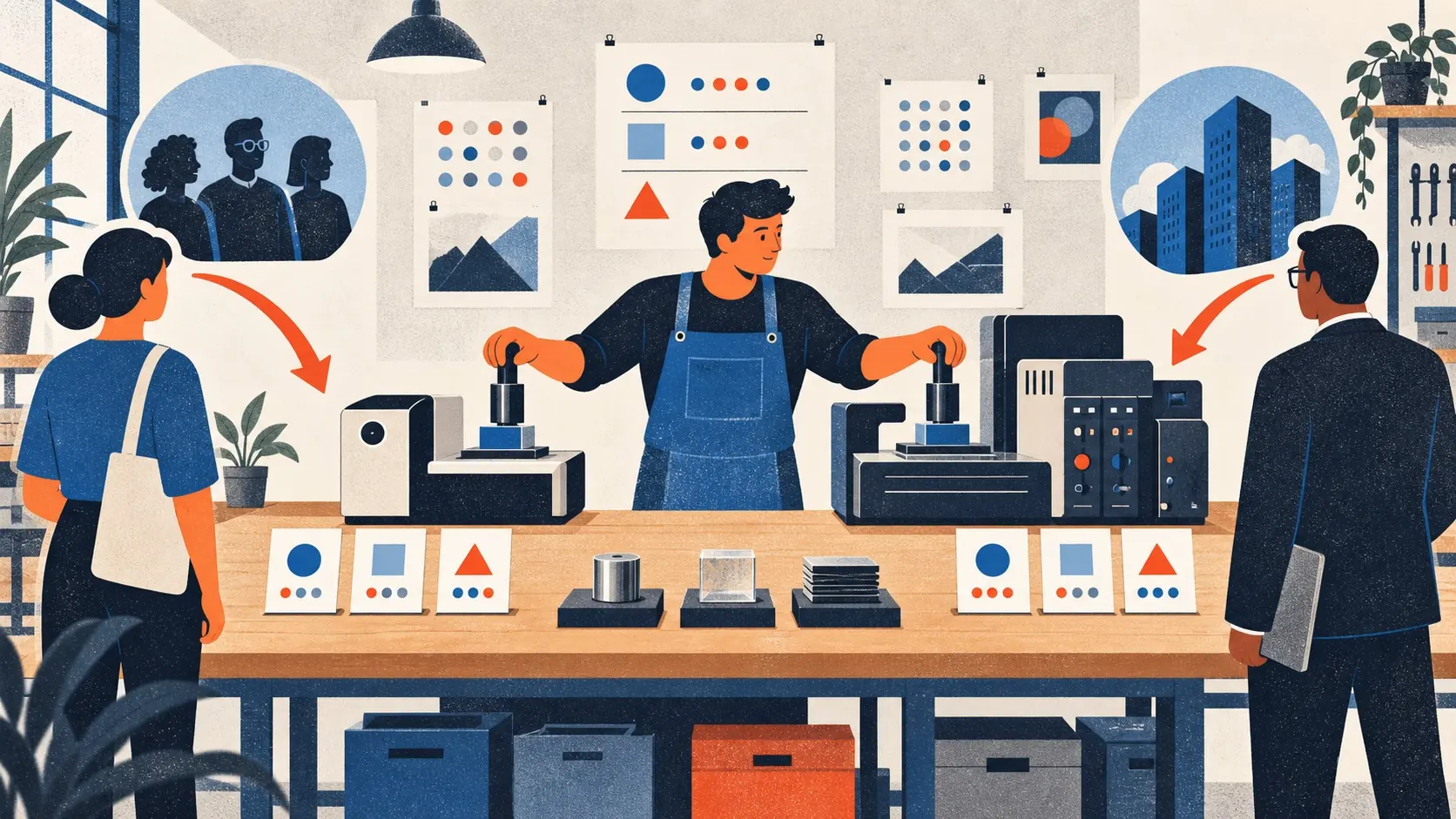
A comparison page is useful when a buyer is already choosing. It is dangerous when the writer pretends the choice has only one honest answer.
Most startup comparison pages begin with a keyword list. Someone finds searches for “Acme alternative” and “Acme vs NewCo,” copies a feature grid, and declares NewCo the winner. The page may attract a visitor. It also teaches that visitor not to trust the company that wrote it.
A good comparison page helps the wrong customer leave with confidence.
That sounds costly. It is cheaper than selling a bad fit, disappointing the customer, and preserving an unsupported claim for search engines and agents to repeat.
Start with a real buying decision
Do not begin with the competitor. Begin with the choice.
Who is deciding? What are they trying to complete? Why are these products plausible substitutes? Which constraint changes the answer?
“LaunchReady vs Competitor” is not yet a useful subject. “Which launch checker should a solo founder use before accepting the first payment?” is closer. It names a user, a moment, and a consequence. The comparison can now examine the facts that matter to that decision.
Useful decision factors might include:
- whether the product tests a public URL or requires repository access;
- whether findings include evidence and reproduction steps;
- whether a report is private by default;
- whether setup takes minutes or days;
- whether the buyer needs one launch check or continuous monitoring;
- whether price grows by user, project, scan, or usage;
- whether a required integration is available on the current plan.
If the products do not solve the same job, say so. If one is a service and the other is software, explain the trade. If the comparison exists only because a keyword tool paired two names, do not publish it.
Use both products before judging them
A pricing page can tell you the price. It cannot tell you whether the workflow is clear, an export is useful, or a failed task is recoverable.
Run the same realistic task through both products. Use the same inputs, user type, device class, and success condition. Record the plan, version, region, and date. Capture evidence you have the right to publish. Keep private customer data out of the test.
Google's guide to writing high-quality reviews recommends evaluating from the user's perspective, showing evidence of first-hand experience, using quantitative measurements where useful, explaining differences, and covering the circumstances in which each option fits. That is a stronger editorial brief than “mention the target keyword eight times.”
You do not need to test every feature. You do need to test the features on which your conclusion rests.
If you cannot access a product, narrow the page. Compare only facts available in current primary documentation and label the result a documentation comparison. Do not turn a missing test into a confident product judgment.
Keep an evidence ledger
Before drafting prose, make a small private ledger for every material claim.
| Claim | Evidence | Verified | Scope | Status | | --- | --- | --- | --- | --- | | Supports SSO | Vendor documentation | 14 Sep 2026 | Enterprise plan | Verified | | Setup took 12 minutes | Recorded test | 14 Sep 2026 | New account, desktop | Observed | | Easier for small teams | Test notes plus three interviews | 14 Sep 2026 | Teams under five | Interpretation | | Cheapest option | None | Not verified | All plans | Remove |
The ledger prevents three common errors: a true statement with a missing condition, a past fact presented as current, and an opinion dressed as measurement.
Use four labels in your working notes:
- Verified fact: a current source or repeatable test supports it.
- Observation: it happened in a named test or customer situation.
- Interpretation: you drew a conclusion from stated evidence.
- Unknown: you could not establish the answer.
The published page does not need badges beside every sentence. The prose should preserve the distinction. “The enterprise plan lists SSO” is a fact. “We found the initial setup simpler in our test” is an observation. “This may suit a small team better” is an interpretation. “Competitor is impossible to use” is theatre.
Compare jobs, not the number of ticks
Feature grids invite dishonest arithmetic. Ten minor ticks can make one missing critical capability disappear.
Group the comparison around the buyer's work:
- Getting started.
- Completing the core job.
- Collaborating or handing off.
- Recovering from failure.
- Understanding cost at expected usage.
- Meeting security, privacy, or procurement needs.
- Leaving with data intact.
Within each group, state why the criterion matters. A founder choosing a one-off launch audit may care more about time to first result than team permissions. A regulated company may reverse that order.
Do not award a point for having a feature. Explain whether it changes the outcome. An API is not an advantage to a buyer who will never integrate it. A smaller product can be better because it omits work the customer does not need.
Put changing facts on a short leash
Prices, plan names, limits, integrations, support terms, model access, and security claims change. Treat them as expiring facts.
Link to the primary source beside an important changing claim. State the plan and currency. Include the date checked. When a price depends on usage, show a realistic example and its assumptions instead of announcing one product “cheaper.”
Create a review interval based on volatility. Pricing may deserve a monthly check. A documented export format may need review after release notes change. A company founding date may not need routine review.
If you cannot maintain the page, remove the unstable detail, mark the comparison historical, or retire it. A stale page with a fresh date is worse than an old page that admits its age.
The website trust guide applies the same rule to your own pricing, policies, support identity, and public promises. A comparison page should not demand more consistency from a competitor than your site provides.
Say where the competitor wins
The fastest way to make a comparison believable is to concede a real advantage.
This is not politeness. It is useful qualification.
Write a short section for each product:
- Choose this when these conditions are true.
- Do not choose it when these constraints are present.
- Confirm these facts before buying.
Perhaps the competitor has deeper administration, more integrations, or a longer operating history. Perhaps your product is faster to try, narrower, or easier for a founder to understand. Neither set of strengths produces a universal winner.
Specific exclusions improve conversion quality. “Choose the competitor if you need on-premise deployment” may lose a signup and save three sales calls, a failed pilot, and a resentful customer.
The Federal Trade Commission's comparative advertising policy supports truthful, non-deceptive comparisons and says the basis of comparison should be clearly identified. Advertising law varies by place and claim, so get appropriate advice when the stakes justify it. The practical rule for a founder is simpler: do not publish a factual claim you cannot substantiate.
Use the right page for the query
Three search patterns ask different questions.
“Your product vs X”
The buyer has narrowed the field. Compare the products directly for a defined use case. Explain the method, conditions, strengths, and exclusions.
“Alternatives to X”
The buyer may dislike a price, workflow, missing capability, or company policy. Ask which constraint caused the search. Present a small set of genuinely different options and explain the reason each belongs. Your product does not have to appear first.
“Best product for Y”
The buyer begins with a job. Define “best,” disclose your relationship to the products, and show why the criteria fit that user. If your company cannot evaluate the field with some independence, publish a narrower guide instead of a pretend ranking.
Do not force all three intents into the same template. The pages may share evidence, but the decisions differ.
Do not fabricate first-hand proof
Screenshots, recordings, sample outputs, timed tasks, and test notes can establish experience. Use them only when you are allowed to publish them. Remove personal data, secrets, internal URLs, customer records, and licensed material you do not control.
Do not create a synthetic screenshot and present it as a competitor's interface. Do not copy testimonials. Do not infer security controls from a logo strip or uptime from one afternoon of testing. Do not call a feature absent because you failed to find it.
When the source is public documentation, name it. When the result comes from your test, describe the test. When the conclusion comes from judgment, own the judgment.
This separation also helps answer engines. A stable page with explicit entities, dates, sources, and limits is easier to quote accurately than a page full of unlabeled superlatives. The guide to SEO for AI search explains why durable public facts matter more than special machine-facing prose.
Keep structured data modest
Use article and breadcrumb markup when it matches the visible page. Identify the publisher, headline, date, image, and canonical URL accurately.
Do not add a fake aggregate rating because the page compares products. Do not mark your own sales claim as an independent review. Do not place prices or availability in structured data if the visible page says something else.
Structured data summarizes a page. It does not certify the comparison.
Put programmatic pages behind a publication gate
Once one comparison performs, the temptation is to generate fifty.
Do not let a competitor name and a swapped introduction count as new evidence. Require every page to pass a gate:
- the products are plausible alternatives for a named buyer;
- the comparison has a distinct decision and criteria;
- material facts have current sources;
- someone tested the decisive workflow or clearly disclosed that they did not;
- the page states where each product fits;
- changing claims have an owner and review date;
- the page offers a complete answer before its call to action;
- a human editor will defend every sentence under their own name.
If the page fails the gate, keep it as a research note. The programmatic SEO guide shows how to require source contracts, evidence thresholds, and a small proof set before multiplying a template.
Google's people-first content guidance asks whether content serves an intended audience and would still be useful to people who came directly to the site. It also warns against producing content mainly to attract search traffic. A comparison page that exists only for a competitor keyword fails that test before the copy is written.
Publish a visible method and correction path
End the page with a compact note:
- who performed the comparison;
- what was tested;
- which plans, versions, and regions applied;
- when facts were last checked;
- where primary sources can be found;
- how a reader or competitor can submit a correction;
- whether the publisher sells one of the products.
Correct factual errors quickly. Record meaningful changes. Do not quietly rewrite the method after a complaint.
A competitor who points out a stale limit has helped improve the page. Treat the correction as maintenance, not an attack.
A comparison-page launch checklist
Before publishing, answer these questions:
- Is there a real buyer who would compare these products?
- Does the page name the job and the conditions that change the answer?
- Did we test the decisive workflow under the same conditions?
- Can we support every price, limit, capability, and performance claim?
- Are facts, observations, interpretations, and unknowns kept distinct?
- Does each product have a credible best-fit case?
- Are sources, plan names, dates, and assumptions visible?
- Does the page reveal our commercial interest?
- Can someone request a correction?
- Is there an owner and next review date?
- Would the page still help if search engines sent no traffic?
If the last answer is no, the page is not ready.
Search demand can tell you that a decision exists. It cannot do the research, choose honest criteria, or maintain the facts. Earn the query by making the decision easier.